May Day, Baby
Mattia Cavani
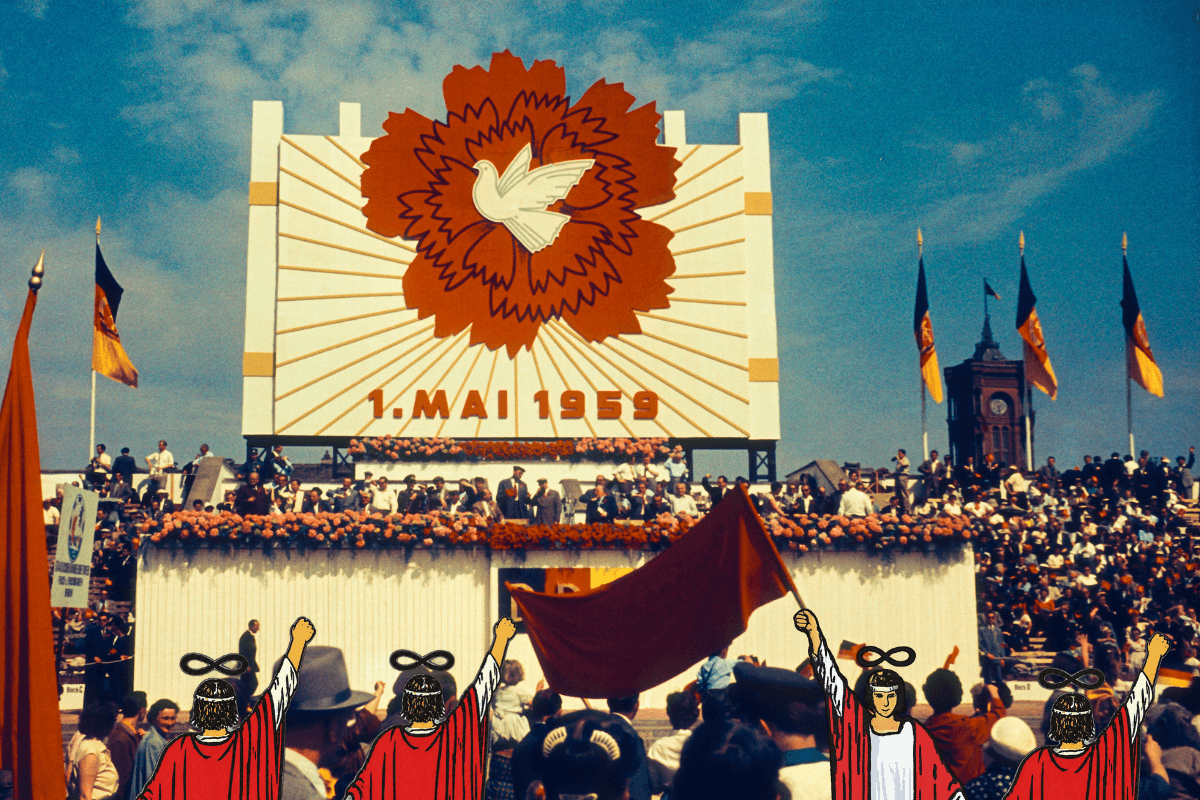
On this May Day, the spirit of global capitalism can be summed up in two phrases.
The first comes from a message exchange that was revealed during the trial in which Live Nation–Ticketmaster was found guilty of monopolising the ticketing and amphitheatre markets in the United States.
Robbing them blind, baby!
The sender was referring to concert ticket prices, which have risen sharply in recent years. However, the monopoly has also affected local promoters, arena owners, musicians, and technical crews. Any entity that did not submit to Live Nation–Ticketmaster has essentially been wiped out or has seen its earnings dry up.
Another emblematic expression is “organised irresponsibility”. I came across it while reading the latest Quaderno published by Fondazione Brodolini, which summarises the investigations conducted by the Milan’s Public Prosecutor’s Office – or rather, by a single magistrate, Paolo Storari – into some of the leading companies in logistics , delivery , fashion, luxury goods and large-scale retail. Many of these companies have ended up in “amministrazione giudiziaria” – a court-ordered regime in which a judge-appointed administrator takes over the running of a company.
The Chain of Irresponsibility
The public prosecutor’s office intervened with the aim of bringing supply chains, which included outright “criminal enterprises” and cases of inhumane exploitation within a long chain of subcontracting, into the legal fold. The impact of these investigations is illustrated by the fact that a total of 61,152 workers were hired or given permanent contracts as a direct consequence (the figure was announced during a conference at the University of Milan). This is the equivalent of a medium-sized city’s worth of exploited people, on whom the profits of companies such as Armani, Loro Piana, BRT, Uber Eats and many others were based.
For legal experts, “organised irresponsibility” describes situations in which the lead company minimises its civil and criminal liability for incidents arising within its supply chain. However, I believe this category can also be applied to other sectors, not just in Italy.
Consider companies, whether tech-related or not, that are laying off workers on the grounds that they will be replaced by stochastic parrots (aka artificial intelligence). Unless one is prepared to take the bombastic and apocalyptic claims of Silicon Valley’s serial liars at face value, it is clear that restructuring a company to facilitate the widespread use of these tools does not signal a desire for innovation or efficiency, but rather a decision to lower the quality of a service, product or process while disregarding the consequences. This makes for a smooth outsourcing process, without even the bother of setting up a cooperative to avoid paying social security contributions and severance pay – an all-to-common scheme in the Italian economy.
“Organised irresponsibility” also seems an apt description of Hoepli’s rapid closure. Founded over 150 years ago, Hoepli is one of Italy’s oldest and most prestigious publishing houses, and it is still owned by the Hoepli family. However, this story came to an abrupt end when the three brothers on the board voted to liquidate the whole operation in order to realise a huge capital gain on the building housing the bookshop in Milan. Eighty-nine workers were made redundant overnight – so much for the family business and enlightened patronage.
This epidemic of organised irresponsibility is a deliberate choice to disintermediate the relationship between oligarchs (and their ilk) and profit. Their ultimate goal is not just the destruction of industrial relations that we have witnessed in recent years, but the complete elimination of the relationship with workers: managed by a foreman in a warehouse, monitored by an app while working, or replaced by a chatbot – it makes little difference.
Too Big to Care
This sense of omnipotence does not exist in a vacuum; it is the result of a power dynamic: merger after merger, too many companies have grown large enough to simply not care about the consequences of their actions. If I am so powerful that I need not worry about intervention by public authorities – whether corrupt and/or intimidated – and if my market power is so vast that neither my consumers nor my suppliers have viable alternatives, what can stop me from doing everything in my power to maximise my profits at the expense of everything and everyone, including the entire planet?
The consequences are plain for all to see: consider the impact of private equity on cities and healthcare, or Big Tech’s attempts to ruin the internet. Perhaps the extreme of this trend is illustrated by the report “From Economy of Occupation to Economy of Genocide” by the Special Rapporteur on the Palestinian territories, Francesca Albanese: major banks, logistics companies, IT companies and energy companies have played a crucial role in perpetrating the genocide in Gaza. These are all civilian, non-military companies – giants that have found a structural, if not political, affinity with Israel’s total expansionism.
The progressive degradation of every aspect of civil life and the excessive display of power dynamics provoke reactions – sometimes violent and sometimes on a mass scale (No Kings!) – and certainly give rise to new ideas.
In this sense, strategies to combat the “enshittification ” of digital services, antitrust measures, and collective action by workers are all tools that can be used to achieve the same goal: to counter the excessive power of an unchecked capitalist class. It seems telling that the Milan Public Prosecutor’s Office is working alongside the Antitrust Authority . However, it is problematic that trade unions have played virtually no role in this investigation – perhaps they feared encroachment on their field. If that was the case, the field was left wide open, abandoned.
The good news is that it is never too late to start: the space left empty by unions is getting filled by various initiatives, often self-organized, that connect workplace struggles to the broader degradation of living conditions for everyone — building resistance to corporate power on multiple fronts. Recently, a petition against the merger between Warner Bros. and Paramount surpassed 4,000 signatures , with almost all of Hollywood’s creative community voicing their opposition. They cited concerns over excessive market power, reduced film production, falling pay and rising consumer costs. In France, two protests have shaken up the sleepy world of publishing. First, the booksellers’ union succeeded in ousting Amazon , one of the main sponsors, from the Paris Book Fair. A few weeks later, more than a hundred authors – a group which has historically been among the most fragile and “cautious” when it comes to collective action – announced a unilateral termination of their contracts following the dismissal of the director of Grasset, a historic publishing house acquired by Bolloré, a tycoon with links to the far right. There are many more examples if you look for them, such as Redacta’s participation in the antitrust investigation into educational publishing or the network freeing libraries from digital locks .
The Italian Wild West
In Italy, looking at the creative and cultural sectors, and at intellectual professions in general, there is still much to be done. Sectors where self-employment is most widespread are, as things stand, still a wild west when it comes to workers’ protections. According to the latest ISTAT (Italian Institute of Statistics) surveys, we are talking about a highly diverse group of over 5 million workers.
For these workers contracts, where they exist, are essentially tools designed to safeguard the client’s interests, such as ensuring timely delivery, transferring all rights to exploit intellectual property, and including non-competition and non-disclosure clauses. They also shift all liability onto the worker, civil liability over the content itself, but also liability for any delays and for revisions requested when the deliverable is not approved. Furthermore, there are no safeguards for self-employed workers against discrimination based on trade union membership.
In this situation, many new forms of collective action have emerged in recent years, often outside of traditional trade unions. These experiences were born precisely out of taking responsibility — for defining both the substance of one’s work and its fair compensation. I am not just talking about ACTA and its sections; I am thinking of initiatives such as UNITA in digital animation and AWI in the arts.
For those who work in these sectors, the experience of signing a freelance contract or a copyright transfer agreement is indistinguishable from that of a consumer blindly accepting every clause of whatever they are made to sign just to use a service: that feeling of powerlessness, of agreeing to things that will screw you over, that laws in your favor don’t exist or simply don’t count, while those that can punish and discipline you do — those most certainly do. That very contemporary feeling of surrender, of a constant pressure to drop it, to let it go.
This weakness is also fertile ground for the temptation to indiscriminately use LLMs to simulate one’s own work performance. This seduction by mediocrity, by the production of identical texts, by the creation of stereotyped images, may be the most effective tool left to secure consensus for the large corporations that govern our time: a relationship of dependency (on software, on data centers, sometimes emotional) born of a surrender of one’s capacity for creation and reasoning — an outsourcing that leaves us without words, without thoughts, disarmed the moment we disconnect from the machine.
It doesn’t have to be this way. There is no reason to surrender to a world that, in terms of conformism and obtuseness, resembles a LinkedIn feed (by the way, according to a recent study , there is a correlation between appreciation for the buzzword-laden jargon that floods corporate slide decks and LinkedIn, and poor critical thinking)
On this May Day, let us celebrate universal solidarity between all those who struggle, from GLS porters in Naples to software developers, and their capacity to change the world, to build organized accountability over their own work.
Let’s celebrate in defiance of bosses, both big and small, and their sad passions. Let’s celebrate because we’re still here: like the Magician in a deck of tarot cards, we have all the tools we need to shape our own destiny right before us. Let this May Day give us the strength to seize them.
Follow the blog and stay connected here .
- Collective Action
- Supply Chains
- Organised Irresponsibility
- Monopsony
- Freelance Work
- Italy
- Antitrust
- Platform Economy
- Live Nation
- Ticketmaster
- Acta
- Un!ta
- Warner Bros
- Paramount
- Artificial Intelligence
- LLMs
- Paolo Storari